Tag Archives: Google Translate

Google Translate in a fourth-grade classroom

13 November 2019

I teach the fourth grade in a public elementary school in the suburbs of a large U.S. city, and in my classroom I often have a child or two with very limited English skills. These kids are 8 or 9 years old and often here with parents who are stationed temporarily in the U.S. They get daily or weekly time with the ESOL (English for Speakers of Other Languages) teacher, but other than that, they are fully integrated into normal American classrooms.

I use Google Translate with these children in a very focused, need-to-solve-a-problem basis. I have a specific question I need to ask, an instruction I need them to follow, or I need to get information from them. Things like, How are you going home today? Are you going to buy lunch in the cafeteria today or did you bring a lunch? You know, the kinds of daily activities in the life of a classroom.

When I was in the third grade my dad got posted in a foreign country for a year, so I actually know what it’s like for those kids. You’re just sitting there in a fog while everyone around you speaks Russian or some language you can’t grasp. Nowadays I have a tool I can use to help kids in a similar situation through the school day: Now we’re going to do this. This is what you need to do. Those kinds of things are important for their general feeling of well-being, that they can manage the school day.
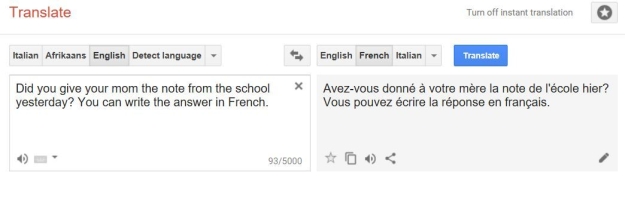
Julia_GT excerptI sometimes use it in other ways. During writing lessons, I might have a child write in their native language. Then I copy/paste that into Google Translate so I have an idea of what they’ve written. I figure at this stage, writing in your own language is better than trying to write in English. I’ve even tried translating larger blocks of text for a student to read so they can at least know what is being discussed in class.

The languages I’ve dealt with so far are French and Spanish. I had Latin in high school so I can recognize word derivations and root words and can be somewhat assured that what’s been translated is moderately close to what we’re talking about.

When you’re communicating this way, you have to read between the lines a bit. It’s usually so situation-specific that you can get the meaning, but once in a while it takes some back-and-forth questions and answers to narrow things down and get an understanding. Luckily if we hit a dead end, I usually have a backup: a school employee or another child who speaks the student’s language. If that method fails, we can always call the parents to sort things out. At least one of them usually speaks English.

As the kids learn more English, I find myself using machine translation more. I can tell that they are starting to understand me a bit and I want to communicate more. I first say something then I type it into Google Translate. They can see the connection between what I’m saying, what I’m typing, and then what it goes out to in their own language.

I feel like machine translation is a resource that I can use to move to the next step. It really feels like a bridge for understanding.

Whatever else happens, I want these kids to feel like they are understood.
Helmuth, University Lecturer

29 October 2018

I use machine translation to communicate with a PhD student in another country about her academic work in our field of translation studies. She is researching a topic I know well and have written several articles on, and we have had a kind of e-mail collaboration going on for several months now.

The main language of our discussions is English, but there are several other languages involved. My command of English is more of a passive one, I am of course much better with my native German. Her English seems to be better than mine, though her research work is done in French and her native language is Chinese.

It usually works like this: She writes me mails in English. My English is good enough that I can read them directly. I want my replies to be well thought-out so that they are useful to her, so I write and edit them in German until I am satisfied. I then put the German text into Google Translate and translate it into English. I still edit the English a bit, most often to correct mistranslations of keywords from our specific field. When it’s all ready, I copy/paste the English into the mail.

I actually often include the original German text too. Sometimes I do that because I’m not 100% sure the English version came out saying what I wanted to say or if it will be clear enough. I figure that if I include the original, then she can compare the English with the German, or try machine-translating the original German into a language she knows better, like French or Chinese. Or she may even have access to a different MT tool that gives her better results.

Strictly speaking, we wouldn’t have to do this through machine translation because I do know some English. But it would take so long for me to produce English from scratch! I would sit for hours looking up individual words. I would definitely end up writing shorter and simpler messages, plus I would write less often. I’ve decided using machine translation is the fastest and best method.

Actually this is not the first time I’ve used this kind of solution. 10 years ago I had some collaboration with an academic in Spain and we used it then. We each visited the other’s university and we spoke English when we were together. But for all the communications needed to plan and organizing these visits, we used Babel Fish to translate between German and Spanish. That worked well. We once had a slight misunderstanding that came from the translation of one word, but it was soon cleared up because the context made it clear that it didn’t mean what he thought at first. It can happen that way sometimes – the context corrects things.

Of course the texts you translate in Google are not ready for any kind of publication. That is clear. But for this purpose, it is a valuable tool that saves me time and makes things easier.

Having said that, I’ll add that on the other hand, I find it interesting that people seem to want to believe that language is a system that can be mechanically produced. So much money – millions – has gone into researching these systems. Much more money than they’ve used for more sensible things. I guess it’s just the way people think; they don’t remember that words are only signs that represent mental concepts. The full meaning of words comes only through their relation to a specific situation and context.

Krista, language and communications professional

31 August 2018

My English, French and Swedish are all strong and I studied them at the university, but German, Italian and Spanish are languages I haven’t studied since high school. I have a university degree in translation and I worked as a professional translator for some years, but for the past 15 years I’ve been more of a communications professional. I am the Managing Director of a national non-governmental organization and my job consists mostly of communications.

Rich use of Google Translate

I’ve been using Google Translate for many years now. Not in translation work, of course, but for a variety of other things. First of all, I use it to help me make sure I understand texts that are in languages I am not fully fluent in. I read articles, newspaper stories and research papers that have to do with my industry and are in a variety of languages. When I come across a passage I’m not sure I understand, I google-translate it into my native language of Finnish and also into English (usually both, not sure why…maybe curiosity? Or because I love languages?) I also want to know what similar organizations to mine are doing around Europe so I find myself google-translating web pages or other documents to be able to read them.

Sometimes I use the tool to help me when I have to write something in Swedish, which I struggle with a bit. I might write a piece and test it out in Google Translate to make sure I got the phrasing and spelling right. I also test it in regular Google to see if it’s a common way of expressing what I’m trying to express.

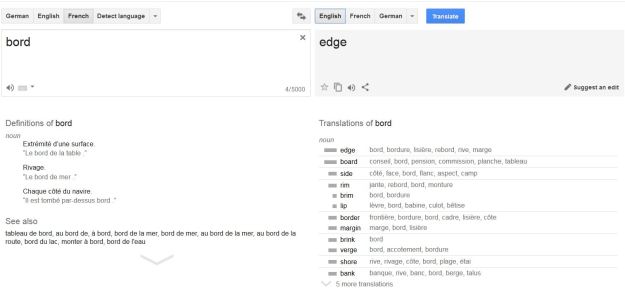
I guess the funny thing is that my most frequent use of Google Translate is not really for its translation function. I most often use it as a dictionary. I don’t have a good electronic dictionary at my disposal and I’m a bit lazy about looking things up in books. So I either google the word or use Google Translate to find the meaning. I don’t really look at the translation but down below, where they give dictionary-type information. Here’s an example:

GT dictionary

I like that it gives me multiple suggestions for a translation. I couldn’t ever see myself simply taking the 1 translation it gives in the box and using that. More context helps me make sure I understand.

This also works very well as a thesaurus, a bilingual one at that. It gives you optional synonyms in both languages. And one more thing, a feature I noticed just this year! The megaphone icon at the bottom of the word boxes? That is a pronunciation audio tool.

These kinds of language tools are included in many online dictionaries in different languages, but this is an easy option for multiple languages. Quick.

Oh, and I don’t know if you’ve noticed or not, but they want people to help develop Google Translate. I’ve done some volunteering there, mostly in English since that’s the easiest. You click through expressions and words and see if they’re correct or not. It’s kind of a game and helps to develop it. It’s fun.

Double-checking

Google Translate is hardly ever the only thing I use to verify the meaning of a text; normally I double-check it some other way. Even though it’s just for my own use, I work hard to get a good translation.

First of all, I only use it with languages I know well or at least a little. By comparing the original text and the translation, I know enough to know if the translation is something it’s supposed to be. I would never use it with languages like Arabic or Chinese because I would have no way of knowing how ‘right’ the translations are. I also try out translations with different language combinations, often including English somewhere. Because I have background knowledge on how machine translation works, I know that it works best when English is one of the languages used.

Another way I verify things is by putting them into regular Google. If I can see the same phrase and how it’s used in different contexts, then it can help me fully understand it. Usually when this happens it’s because I’m reading things that are not as familiar to me, like academic or technical texts.

The question of machine translation

I don’t go around recommending the use of machine translation to other people, no. Most often that’s because people need a translation for a text they want to give to someone else or publish. Then I recommend that they use a human translator, of course, because that is what is needed. I think it’s important to make sure people understand that. Another reason I don’t do it is that, if I were to recommend it to someone outside of the language industry, I can’t be sure that person understands the limits of machine translation.

If someone asks me for advice on using it, say they just want to understand a short paragraph, then I tell them it is useful for that if they understand the risks involved. But I’ve never recommended it as such.

When I first started using machine translation it was a bit of a shameful thing. The attitude in the translation community was definitely negative. I didn’t dare tell people I was using it. Nowadays it seems more acceptable for the purposes I use it for. I suppose in earlier years, up to 2010, people were afraid that machine translation would take all the work from translators and eventually they wouldn’t be needed. But now I think people understand it’s just a tool that can’t do everything we need humans to do. I noticed the shift in attitude sometime around 2014 or 2015. It was discussed in conferences in a different way and people were much more interested in the topic.

Nadal and Fourcade super fan!

17 May 2018

Nadal_FB      Fourcade 3

My name is Pirkko, I’m a 77-year-old woman, and I admit to being a super fan. There are 2 athletes I follow avidly: tennis player Rafael Nadal and biathlete Martin Fourcade (and also, on the side, Fourcade’s biathlete younger brother Simon)

I’m one of those crazy sports fans, the kind of person who gets a tennis channel and watches it. A lot. But I like to do more than just watch the sports, I want to learn about the athletes themselves. Knowing them better and knowing something personal about them – that gives some depth to the whole experience of being a sports fan.

If I were limited to what they write about these guys in the press here in Finland, well, I wouldn’t know much. So I go online to read up on them. I am Facebook friends with both Nadal and Fourcade and both write something almost every day. I like reading those and I enjoy the pictures too – it puts me into a good mood. I feel like it opens up my world.

Since I don’t know any Spanish or French, only a bit of English, I rely entirely on the translations provided by Facebook. No, the translations are not perfect, but I understand that they’re not going to be. The thing is, I know the fields and I know the people involved, so if something is unclear I can make a good guess at what it’s supposed to mean. For example, take the words judge and play. Sometimes the machine gets those wrong, placing judge in a courtroom and play in a music lesson. But we’re talking tennis here, so I know that the real meanings have to do with referees and tennis rackets.

Both Fourcade and Nadal also tend to write messages both in their own language and English, and Facebook gives me translations for both:

Fourcade FB

It’s helpful to have 2 translations. I always look at both translations and put together the meaning from their combination. The translation from English is almost always better than the one from French or Spanish, but I’m looking at an example right now where the translation from French is better. IMHO the translations on Fourcade’s page tend to be better than the ones on Nadal’s, but it could simply be that Fourcade writes more clearly.

When there is a word or post I don’t understand, I sometimes type it into Google Translate. I also have a dictionary, I suppose I should use that more often too (chuckle). If there is a handy child or grandchild around, I might ask them for help, but I don’t go calling my kids to ask. The stuff I am translating is not that important.

Thoughts on machine translation

I found this translation thing pretty much right away when I joined Facebook, so I’ve been using it for more than 10 years now. My friends don’t use it and I don’t really go recommending it to people. I’m old enough that my friends are really not technical – I don’t think I’d have anyone to recommend it to!

I’m really satisfied that there is a tool like this for those of us who don’t know languages. Computers have brought both bad and good things to our lives, mostly good in my opinion, and machine translation is a nice addition to that. Without it, I don’t think I’d follow the athletes as much. Being able to go further and learn about the personal lives and histories of the athletes I follow – it brings openness to my world. 

Max, manager at a large multinational company

7 April 2018

Around 2010 my company acquired a factory in Brazil. Although there were a few native Spanish speakers on my team, no one knew Portuguese. Our Brazilian colleagues did not speak English. I decided I would start studying Portuguese because I had some responsibilities in the acquisition project.

While I was still learning the language, I had a lot of documents I had to review which were in Portuguese. I heard from colleagues about Google Translate and I thought I would try using it to help me with those documents, just to be able to get some idea of what is covered in them. I am by no means a techie kind of person, I’m not that interested. To me, applications are just tools you use to get things done. Google Translate was one of those.

I realized pretty much right away that there are advantages and disadvantages to Google Translate. Use of a machine translation tool is not the same thing as proficiency in a language. But if you understand that and how to use it as a tool, then it is helpful. I ended up using Google Translate for several years while learning Portuguese.

One way I used it was to translate documents from Portuguese to English, to get an idea what they were about. I translated articles in trade magazines, economic reports, excerpts from longer things like books. Things that were not that demanding technically. I would copy/paste an excerpts or whole articles for translation. I never translated anything like legal documents. I seriously doubt Google Translate would produce anything other than harm in those cases.

I usually understood the topic of the things I translated, what they were about. Something about the substance. The thing is that if you understand the context, you can take what the machine translation gives you and connect the dots and bridge the gaps. You get some building blocks and put together the whole picture yourself.

If I didn’t understand something, I could always call a colleague and ask them for clarification. We had very good cooperation with our Brazilian colleagues and they were very appreciative that I was trying to learn their language. They were helpful.

Another way I used the tool was in learning Portuguese and building my vocabulary. I would check the translations of single words in Google. Why didn’t I use a dictionary? Because Google Translate is faster. And when you look up a single word, the translation is almost always correct.

I also used it to check forms in Portuguese, to see if they were correct. I used it along with other language learning materials. When I was trying to produce Portuguese, I would check the form in things I was writing to see if it made sense. That was for informal things like e-mails. For more important things I asked colleagues about things I was unsure about.

I never made decisions based on the information I used Google to translate. Goodness no. Not for big strategic decisions or even smaller ones.

Thoughts on using machine translation

Machine translation does not equal proficiency in the other language. Nor is it a shortcut to proficiency. People are so used to getting things immediately. But it’s not that easy.

You have to have some critical thinking and understanding of the limitations of the tool. When you understand the theory and why things happen the way they do, then use of a tool like Google Translate is nice, neat and handy. I think of it like this: if you’ve studied medicine for 5 years and use information on the internet to help you diagnose symptoms you’ve been having, that is a totally different thing than a person with no background who googles their symptoms.

It is also helpful if you’ve studied the other language involved (the one you’re translating from) and know something about what it’s about. For example, you can spot wrong synonyms that the machine produces. If I were translating from a language I have no idea of, that would be a very different thing. For me it was important to be able to reflect on my own language capabilities – there’s always some kind of reflection on the language.

It should never be used blindly, with the user just accepting what machine translation gives them.