Tag Archives: machine translation at work

Journalist Nina: “The other choice would have been no interview at all”

20 December 2023

On the bus was a Ukrainian man who was willing to talk to me. He spoke very little English and we had no interpreter, but the photographer suggested we try using Google Translator to communicate. I had my doubts about it, wondering if it’s ethically OK to use it that way, because there is a risk that something would go missing in the interview. But there we were on the bus with someone who was willing to talk to us, and we thought it would anyway be better to get an interview than not get one. This arrangement also seemed to be OK for the potential interviewee. A large part of the communication in that interview was conducted through Google Translator.

After that I’ve done more interviews with Ukrainians using Google Translator, but only when they know some English. We do the interviews mostly in English and use the translation app when we run into trouble understanding each other or one of us wants to explain something that we can’t do fully in English. So the translation app is a back-up support for communication instead of being the main method of communicating. But if there is no common language at all or the interviewee’s English is not good enough, then I would consider getting an interpreter instead.

Usually I suggest using a translation app when we are agreeing on the interview – I suggest that we use English with Google Translator as a back-up. Other times I’ve already started interviewing and then the interviewee pulls out their phone to communicate something. I’ve noticed that Ukrainians are used to using Google Translator. You start to talk and they pull out their phones. They’re also pretty good at it, at least if you compare it to how I used it back then. They also often use it with speech – they talk into the phone and then play the translation for you. I used to rely on the writing function but have now started to use it with speech more often.

And things do go wrong sometimes, maybe 5–10% of the time. When you use it in face-to-face communication, you can see immediately if there was a translation failure – I can see from the interviewee’s expression that something came out funny. This happens once in a while, but especially when we are talking about topics that have a lot of specific terminology – then things go wrong more easily. Sometimes I try explaining my way around a topic or asking, ‘Did you mean this?’ Every once in a while, some part of the interview is so hard to understand that I have to consider leaving it out.

Occasionally I use translation apps in other parts of my work too, mostly when reading background material for news articles, and mostly with languages I’m already familiar with. For example, when Shinzo Abe was assissinated, I wanted to read the material put out by the Japanese press. The large Japanese media site The Asahi Shimbun has information in English, but they have different information in Japanese and I wanted to read that. I know some Japanese because I was an exchange student in Japan when I was younger, but not enough to read the content quickly. So I translated the Japanese into English with the internet browser’s translation function, and between the English it produced and my own Japanese, I got deeper information.

I do have some doubts about using Translator. I wonder if the translations are really good enough for it to work or if I should be considering some other option. My biggest concern is that something could get left out or some meaning could go missing. But so far things have worked fine. And then again, the same risk is present when the interviewer and interviewee are both speaking English, which is neither one’s native language.

I think I can take the uncertainty of relying on a translation app pretty well. To me the most important thing is to make sure I understand, and write, the information and facts correctly. It is not as important to get the right tone, because as a journalist, I am responsible for facts and not tone. Some interviewees, especially those that are active in social media, can be strict about their image and might react when the tone of an article is not exactly how they’d like it to be. But the ethical guidelines for journalists make it clear that our job is not to give people good PR but to report on the facts. So facts are my focus, but in getting those facts straight, I still worry that something might be left out.

The people I’ve interviewed, on the other hand, seem to be fine with using a translation app. That might be because they are living in an environment in which all communication is a bit uncertain.

One thing I do to make sure I get things right is to send the article I write to the person I interviewed for comment before I publish it. This is something journalists commonly do, but what I do with Ukrainians is use a translation app to create two versions of the article: one translated into English and the other into Ukrainian. I want to make sure they are able to understand the text well enough to verify that it’s OK or make comments, and that they can comment on things in the Ukrainian translation that I can then check in the English version.

Another principle I have is that, when I’ve relied a lot on Google Translator in an interview, I always mention that in the article I write. I think the reader should know that. If they know anything about translation apps, they’ll understand that things might have happened to the original tone of the interview. That the facts are probably the same, but the tone might be a little different. It’s important to be transparent.

Why don’t I use a human interpreter? Sometimes I wonder if I should consider other ways of doing this. For example, the last time I was going to interview a Ukrainian, I thought seriously about using an interpreter. But the interpreter would most likely not be a professional – we tend to use non-professionals who just happen to know two languages, and my newspaper doesn’t have a process for finding and using a professional – so I figured that, with my decent English and a translation app, the benefit would be the same as if an interpreter does some kind of translation.

Also, in journalism you are always in somewhat of a hurry, which is not always such a good thing. Translation apps are simply faster, and you can get interviews that might otherways take a lot of effort. But I have to admit that there is a bit of pure feeling involved too – I feel like an interpreter would kind of come between the interviewee and me. That might slow down our communication and break the direct connection between me and the person I’m talking to.

In the end, the choice is sometimes to use Google Translator or have no interview at all. I have always felt that, even with the uncertainty involved, it’s more important to get the interview.
Gustav: “With machine translation I can contribute better, also in places where I’m not directly asked.”

7 January 2019

For the first several years I lived in Finland, I worked in a large, very international company and English was the main language used. Even though that is not my native language, Swedish is, my English is very good. But a few years ago I changed jobs and my new job is in a truly Finnish company with only 3-4 non-Finns working there. Finnish is not a requirement (luckily, or they wouldn’t have hired me), but of course people are more comfortable with Finnish. I think this is a great thing actually, I see it very much as an opportunity for me to learn Finnish.

Some of the texts I need to deal with at work, e-mails and documentation on the software products we make, are in English half the time and Finnish half the time. There is no strict language policy. Other texts I need to understand are always in Finnish, like human resources kind of information – things like, what’s the company’s travel policy? What is the procedure I need to follow to take parental leave?

My Finnish is OK-ish. I find it hard to follow spoken Finnish. But with written things like e-mails or instructions, I can usually work out the basics of what I need. The problem is when I need to understand the details. Then I can very often get lost. So what I do is use Google Translate to translate the parts that I don’t understand. Sometimes I do it to get confirmation that I have understood things correctly.

I mostly translate from Finnish to English, not Swedish, because generally I find it works better than Finnish-to-Swedish. Every once in a while if the English translation is iffy or I don’t understand it, I might try translating into Swedish.  

I would say that machine translation works surprisingly well. I use it pretty much daily and 80-90% of the times I use it, it gives me the information I need. I actually work with speech and language technology and I’ve noticed that in the past couple of years, there have been amazing advances in machine translation in terms of readability. I have been using it more and more since I noticed this. It helps that I know the general gist of things when I translate a text – I’m confident that I can assess whether the translation makes sense or not.

When it doesn’t work – I don’t understand something I’ve translated – I go back to the original text in Finnish and simplify it. The original might have little mistakes in it that I correct, or I simplify the content and structure a bit. And then I put it through machine translation again. This often helps. When it doesn’t, I either ask a colleague for help or I simply decide that the text is not that important so I ignore it.

Machine translation really helps me in getting the missing pieces from everyday e-mails and documents. I might get an e-mail with a long discussion thread, all in Finnish, and finally someone forwards it to me to see if I can help with the solution. With the help of Google Translate, I can get a better understanding of the thread and the context of the problem, and then I can answer more questions and answer the right questions better.

What would I do if I didn’t have the help of machine translation at work? Well, I would probably be more blind to the context of things. I might end up ignoring some things, and I suppose I might end up being less cooperative in a way. I would get away with being more in the background. With the translation I can contribute better, also in places where I wasn’t directly asked. 

On a larger scale, one thing that surprises me is how little visible impact machine translation has had on businesses. Take web shops – you rarely see web shops from other places in Europe that have their pages machine translated. You rarely see them available in, say, 25 languages. It seems to me that businesses, even small ones, could be selling across Europe more than they are now. Machine translation could help.

Dr. C. Koby, Physicist*

3 July 2018

Oak Ridge National Laboratory, Tennessee, USA
October 15, 1971

Part of my work as a physicist is to keep abreast of research being carried out in my field. I try to follow activities in all parts of the world, but I am particularly interested in the research being conducted in the Soviet Union. I would guess that something like 15% of the articles and books I need to read in my field are written in Russian. I have no competence in Russian so have to rely on translations to access those materials.

A very positive development in the past few years is a service that my laboratory offers which machine translates articles from Russian to English. They don’t have anyone correct the articles,  you get what the machine puts out. I have personally used the service 10 or so times over the past 3½ years.

I have one simple reason for using the MT service: it is fast. After a request, I can expect to get a machine-translated article back in 1 month, much more quickly than the 9-10 weeks some colleagues report waiting for articles translated by humans.

More time and effort is required to understand machine-translated texts as compared to those written in English – I’d say about double the time. One reason for that is that formulas and diagrams from the original articles do not get translated, so I usually have both the machine-translated text and the original Russian article, and I go back and forth between them. In general, however, I’d say that the quality of the translations is acceptable. In a funny way, over time you get used to the style. You find yourself mentally correcting awkward passages.

I think it’s important to bring up the fact that the machine translation is understandable to myself and my colleagues mostly because we are familiar with the contexts being discussed. We know our own fields well and that allows us to accommodate texts that are not perfect. It is also important that technical terms are translated correctly or at least understandably, and the majority of the time, they are. The most common problem is words that are left untranslated. I don’t know why that happens but it does, and it can affect understanding.

I’ve been asked if it would be possible for someone to completely misunderstand the machine translations and arrive at the opposite meaning from the original. Yes, sometimes the meaning is a bit distorted, but since I know the context of what I’m reading so well, I do not think that it is possible to arrive at the opposite meaning. I have never heard of it happening anyway.

Overall, I’d say that I’m happy to use the service. It allows me to read things I would normally have to wait far longer to get access to. I would, and actually have been known to, recommend the use of machine translation to my colleagues.


*       Instead of being about 1 real person, the persona in this story is a composite that is based on a group of 58 real people who were surveyed by Bozena Henisz-Dostert in the early 1970s (see reference below). The group consisted of some of the first users of one of the first machine translation systems: the Georgetown Automated Translation system, developed in the 1950s and early 1960s at Georgetown University. Although its development was discontinued in 1964 due to lack of financial support, the Georgetown system continued to be used, virtually in its 1964 state, for a decade or so by 2 groups of scientists in Oak Ridge, Tennessee and Ispra, Italy.

The persona in the story was compiled in a straightforward way. I used 23 of the survey’s 51 questions. For each question, I took the most popular answer, or the mean or average of the figures given in answers, to describe Dr. Koby. The name ‘Koby’ came from an internet name generator and does not reflect any one true person.

The story is based entirely on information from Bozena Henisz-Dostert’s article ‘Users’ evaluation of machine translation’ in the book Machine Translation by Henisz-Dostert et al. 1979.

Jani, car dealership owner

10 December 2017

“We use Google Translate just about every day, for different purposes.”

My business partner and I own and run a small used car dealership in Finland. I’m very good with English, I speak it every day, both at home and with customers at work. As for other languages, I took Swedish and German in school because I had to. I remember some things of both languages though I couldn’t really use them to converse with another person. Nowadays we need to deal with information in those languages on a regular basis.

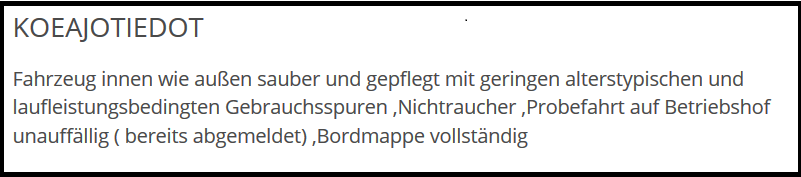
We buy cars from Germany and Sweden and can take care of most of the dealing over the internet: we search for cars in an internet database, decide on which ones interest us, make offers, then arrange for transport, all entirely online. The first, very short descriptions of the cars are often in Finnish since the database’s interface is translated, but attached to each is also a 2-page detailed technical report which is written by a car inspector in the respective countries. These reports are filled with technical terms and it’s extremely important that we understand certain parts of them – the paragraphs that describe the condition and possible problems with each car.  Here’s an example, in which the heading INFORMATION FROM TEST DRIVE (coming from the software application) is in Finnish, but the excerpt of the report is in German:

blog_car0

We copy/paste those parts into Google Translate to get a translation into Finnish:

cartranslation1

If you are among that small percentage of the world’s population that doesn’t know Finnish, here is the same in English:

cartranslation2

As you can see in these examples, parts of the text are translated nearly perfectly. Other parts are not as good. Between what Google gives us and what we remember of our school Swedish and German, we usually figure out what we need to know.

From time to time we also buy car parts from different parts of Europe through eBay. Since we are searching for very specific parts, we just punch in the part number and have no problem locating the products. But we often need to machine translate information on payments and delivery. We use Google Translate for that too.

Normally we translate from Swedish and German into our own language of Finnish. Generally we are confident that the translations are good enough to base decisions on. It’s rare that we have to resort to an English translation because the one into Finnish isn’t good enough.

The decisions we make on car parts involve relatively small sums, but when we’re buying cars, we are making 10 000€ – 20 000€ decisions which are based, in part, on machine translated information. Of course there is some risk involved but we are car dealers – risk is what we do!

How did we come up with the idea of using Google Translate? Everyone does Google! We started using it 3 years ago. We had a need to get some kind of idea on information in another language quickly and that was the fastest way to do it.

If we couldn’t use machine translation for this, it would slow down our operations.